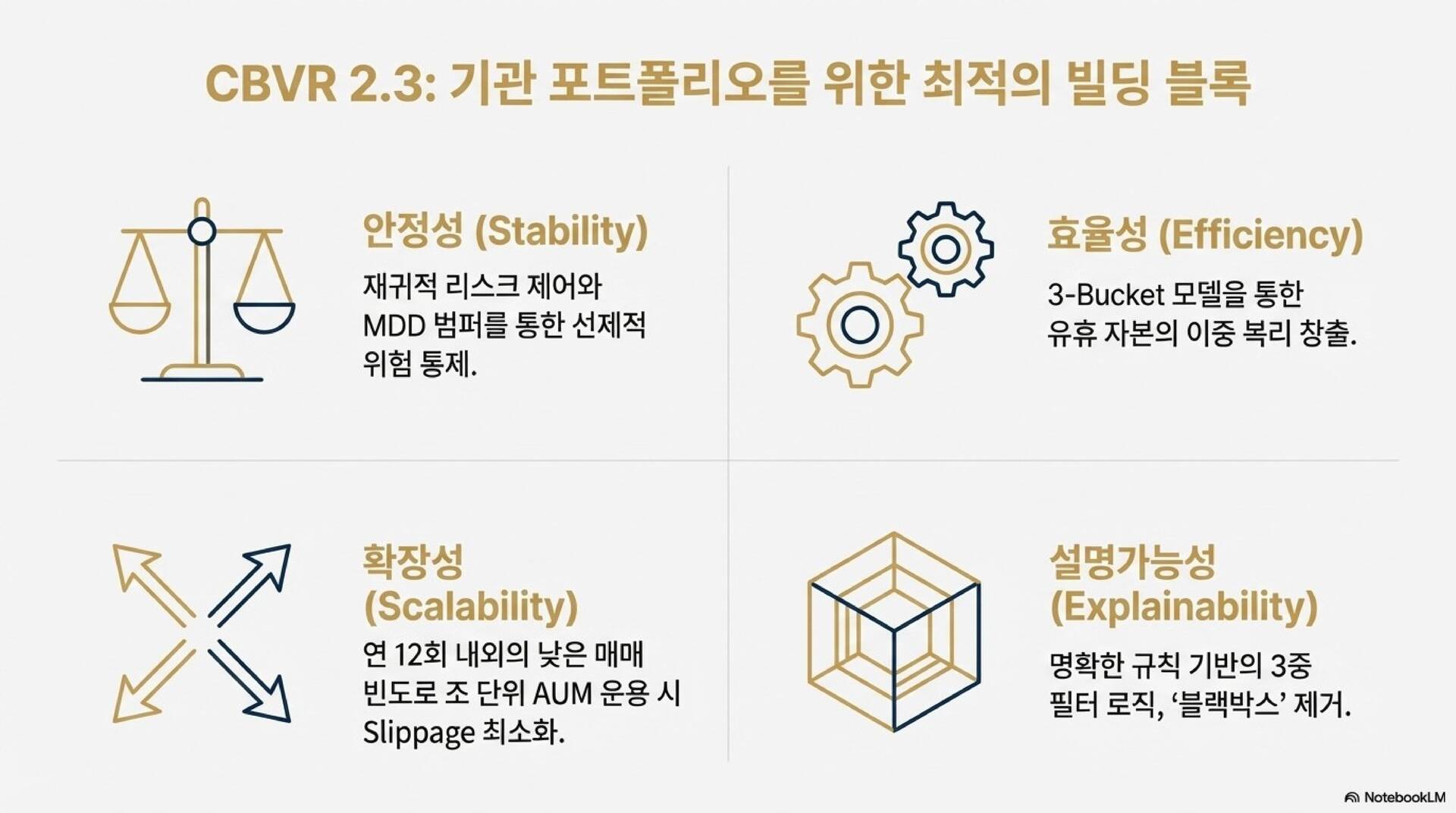
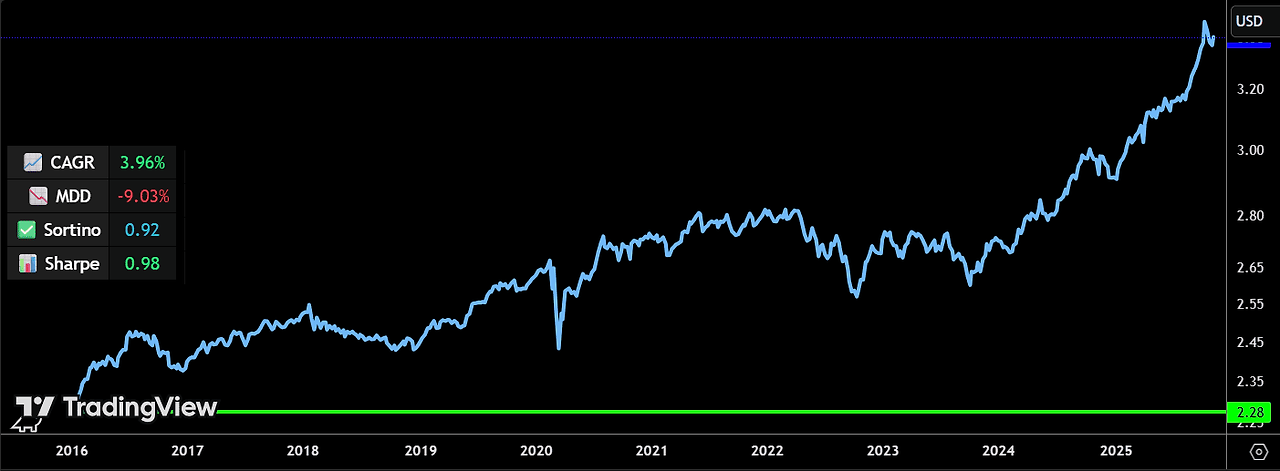
WeJump Investment Labs is an engineering-driven quantitative organization targeting Structural Alpha. The core relies on a dual structure comprising the Adaptive Alpha and CBVR (Channel Based Volatility Rebalancing) strategies. Both strategies are designed prioritizing live-trading reproducibility by internalizing Conservative Underfitting and Worst-Case Cost Assumptions. Adaptive Alpha is a medium-to-long-term directional strategy operating with an average of approximately 8 rebalances per year, equipped with a robust downside defense mechanism (Triple Defense System). CBVR is a regime-aware exposure adjustment strategy, executing 10 to 18 rebalances annually (based on live data) to adapt positions according to volatility regimes. The combination of strategy design, execution engineering, and governance transparency positions the Lab at a level suitable for institutional review in terms of real-world reproducibility.
Definition of Structural Alpha
Structural Alpha refers to the continuous, reproducible excess return achieved when real-world execution constraints—such as transaction costs, liquidity, regime shifts, margin requirements, and liquidation mechanisms—are internalized into the model design, rather than relying on short-term signals or coincidental factors. The Lab holds "the alpha generated when the model is actually executed" as its core value.
Core Principles
- Internalization of Execution Constraints: Performance is calculated by applying conservative assumptions for slippage, commissions, execution delays, and margin rules.
- Conservative Underfitting: Overfitting is suppressed through intentional simplification and the application of conservative parameters. This principle strictly applies to both Adaptive Alpha and CBVR.
- Worst-Case Cost Assumptions: During rebalancing, worst-case scenarios, such as 'liquidating all positions and repurchasing them entirely,' are repeatedly applied to overestimate commissions and slippage.
- Transparency and Documentation: Strategy rules, validation assumptions, and execution logs are clearly documented to ensure external verifiability.
Practical Implications
- Parameter selection prioritizes operational safety over statistical optimization.
- Backtests are validated not under the most favorable assumptions, but under conditions that excessively account for all practically possible execution costs.
- Structural Alpha arises from the ability to convert signals into executable orders, rather than from the signals themselves.
Adaptive Alpha Strategy
- Strategy Characteristics: A directional strategy combining medium-to-long-term momentum and risk management, utilizing long-term moving averages and downside volatility indicators simultaneously.
- Core Components:
- Winner-Takes-All: Positioning concentrated solely on relatively superior assets.
- Gearbox: A phased leverage transition mechanism that expands or reduces leverage based on conservative triggers.
- Triple Defense System: Immediately liquidates all risk assets and transitions to safe assets if any one of three independent risk signals occurs.
- Triple Defense System Rules (OR Logic):
- Price Break: Current price breaks below the long-term defense line (SMA Veto).
- Spread Negative: A negative spread (Spread ≤ 0) occurs between short-term and long-term moving averages.
- Volatility Panic: Downside volatility over the recent 10 days exceeds the system threshold (e.g., 25%).
- Rebalancing Frequency: Designed for approximately 8 times per year on average to minimize trading friction.
CBVR (Channel Based Volatility Rebalancing) Strategy
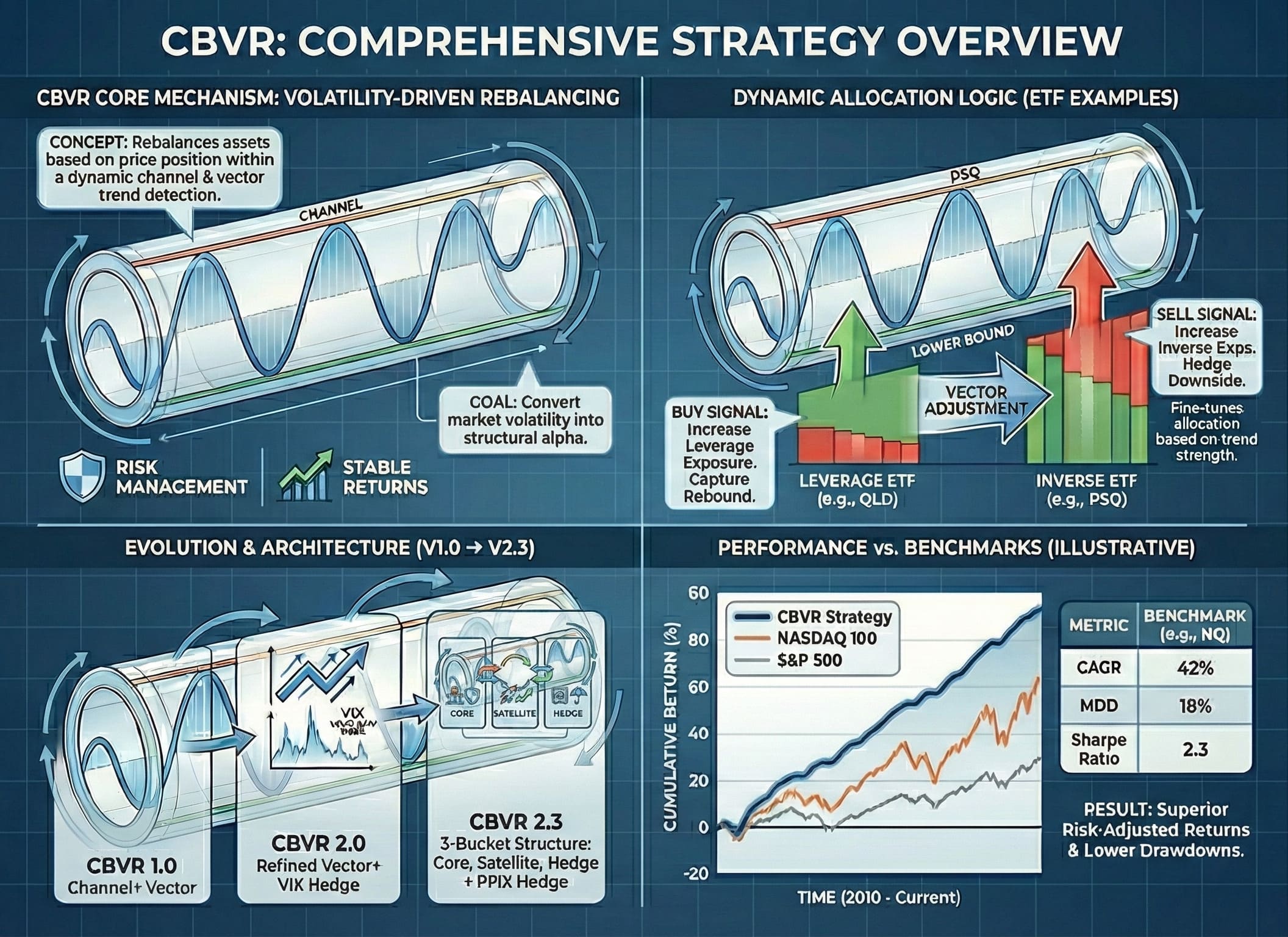
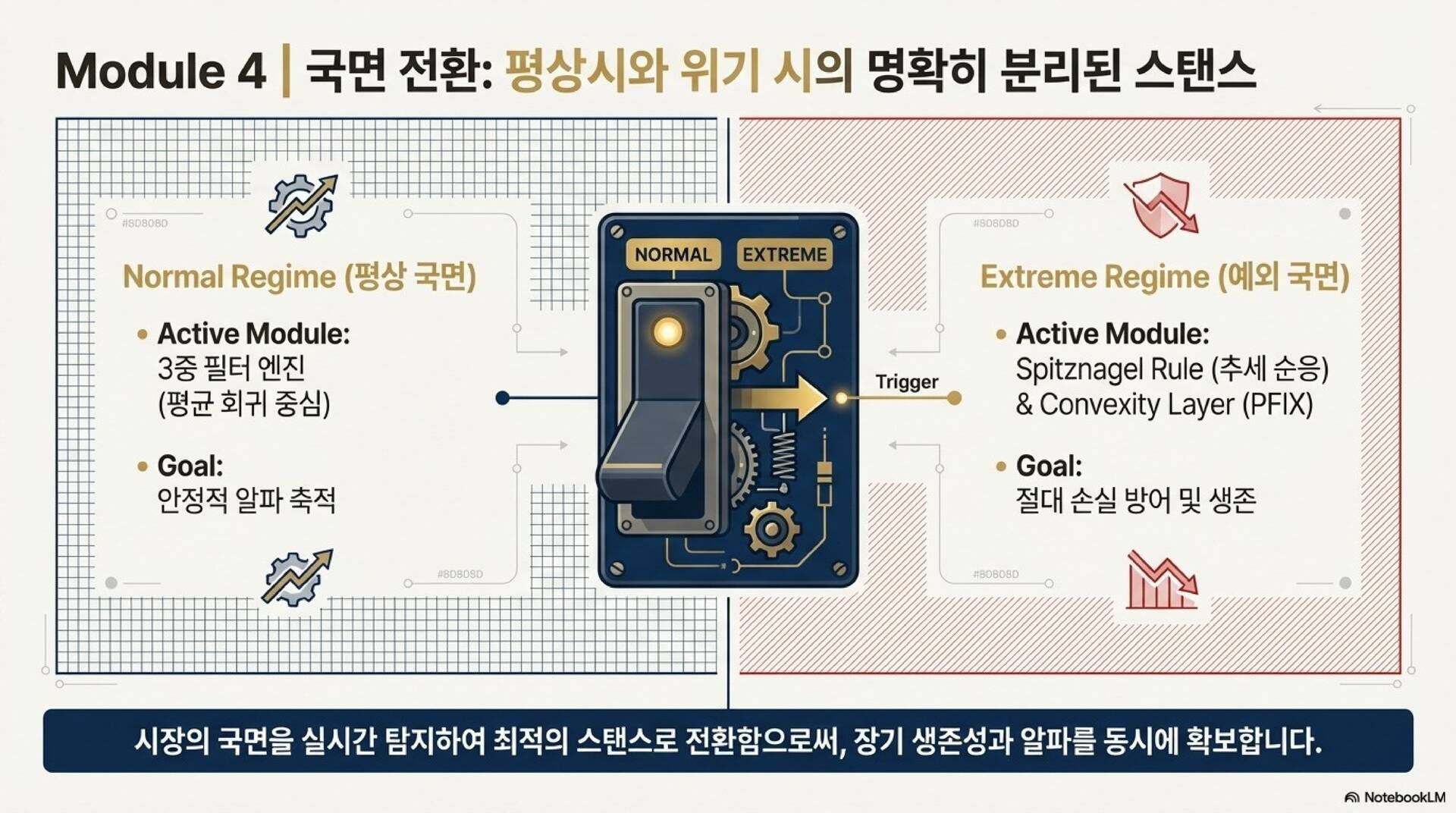
- Strategy Characteristics: A regime-adaptive rebalancing strategy that interprets price as a channel (regime) and adjusts exposure dynamically based on volatility thresholds.
- Core Components: Multi-band channel calculation, volatility threshold-based rebalancing, and regime shift detection logic.
- Application of Underfitting: Conservative parameters are applied to channel width calculations and rebalancing rules to suppress excessive trading and overfitting.
- Rebalancing Frequency: 10 to 18 times per year based on live trading, with frequency dynamically varying according to the volatility regime.
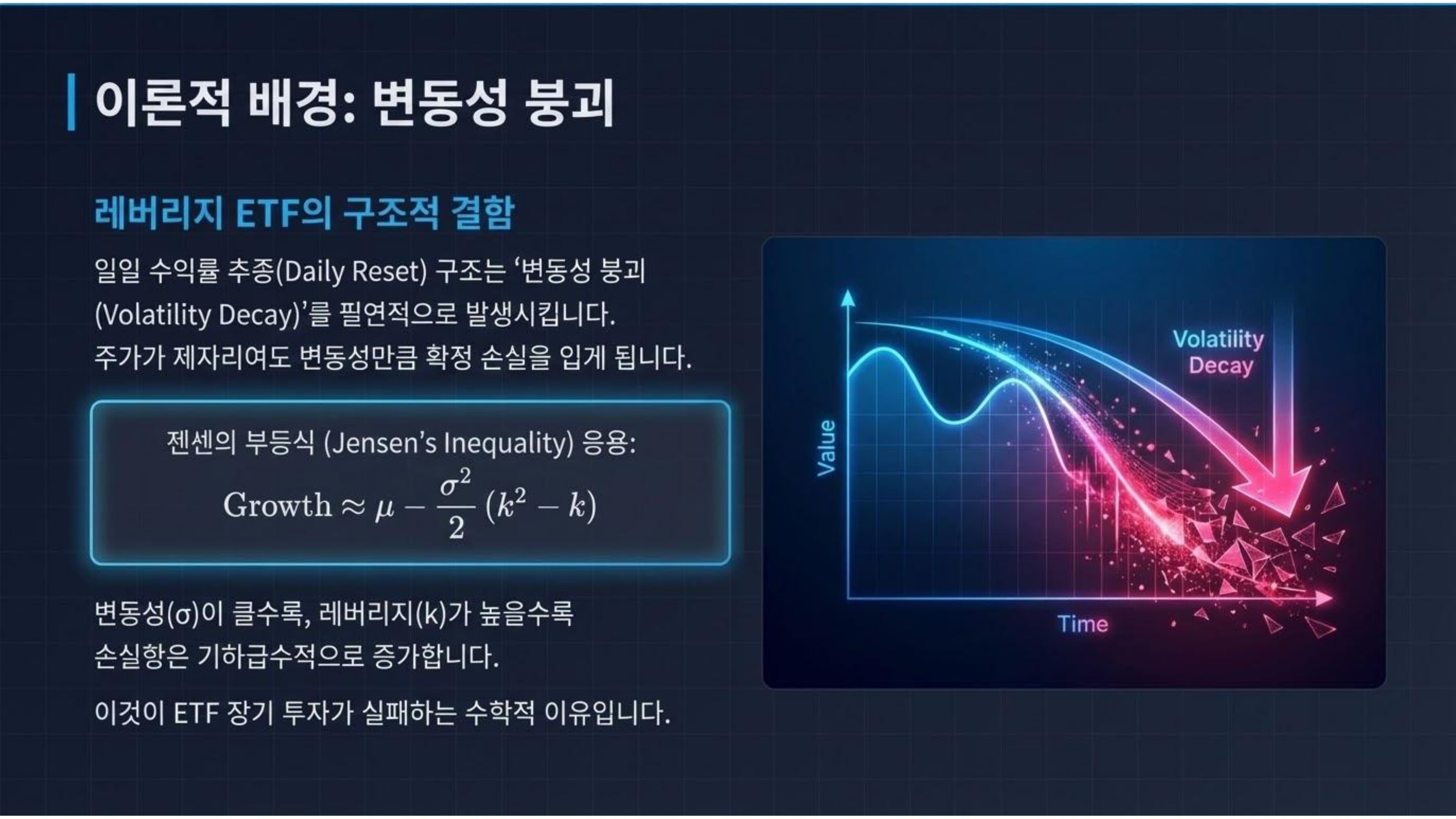
- Operational Objective: Counteracting transaction costs and volatility by reducing trading frequency and maintaining optimal exposure per regime.
- Anomaly Point: A concentration of risk can be observed in segments where the holding period exceeds 5 days. There is a structural possibility of the channel signal being misled when a sudden, sharp contrarian candlestick occurs.
Balance of Speed and Stability
Adaptive Alpha captures alpha through medium-to-long-term directionality and robust downside defense, while CBVR manages position scale and trading frequency by adjusting exposure strictly from a regime perspective.
Recursive Reinforcement
The framework is designed to structurally increase alpha over the long term through a virtuous cycle of: Accumulation of live data → Rule calibration → System reinforcement.
Validation Practices & Assumptions
- All signals strictly use historical data to eliminate Look-ahead Bias.
- For overseas strategies, performance in KRW is calculated through explicit exchange rate synchronization.
- During rebalancing, Worst-Case Cost Assumptions (liquidating and repurchasing all positions) are repeatedly applied to over-account for commissions and slippage. Whether performance holds up under these extreme assumptions remains the core criterion for real-world reliability.
CBVR 5-Day Anomaly Analysis
- Phenomenon: Concentration of losses and volatility is repeatedly observed in segments where the holding period exceeds 5 days.
- Causal Hypothesis: A complex factor driven by the delay in channel calculation, increased slippage due to deteriorating liquidity, and position accumulation effects amplifying losses during a sudden regime shift.
- Detection and Response Logic: Automated warning and position lock based on holding period, Marubozu candlestick filter, shortening of channel recalculation cycles, and forensics through the retention of Execution Logs and Market Depth data when an anomaly occurs.
Leverage and Extreme Scenarios
- Gearbox Design: Designed to immediately lower the risk of margin depletion through phased leverage transitions and conservative triggers.
- Extreme Scenarios: In the event of a severe liquidity collapse, phased reduction alone may not be sufficient, necessitating supplementary emergency rules such as an immediate full-reduction trigger.
Execution Quality and Logs
- Core Metrics: Average slippage, fill rate, order cancellation rate, and changes in Market Depth.
- Impact: Even with low rebalancing frequency, execution quality during large-scale position adjustments dictates final performance. The completeness of Execution Logs is the crux of external validation and institutional acceptability.
Capital Management System
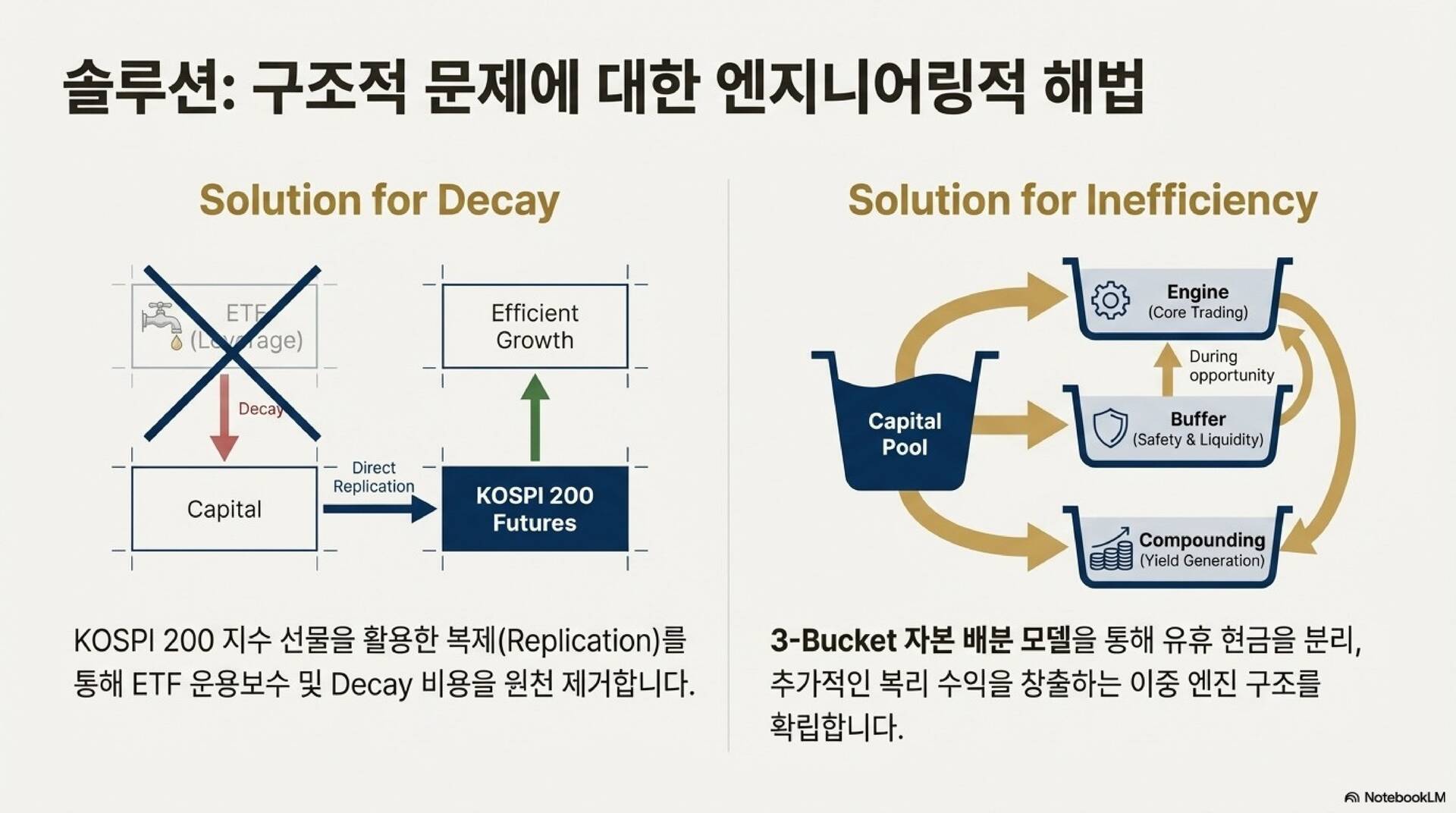
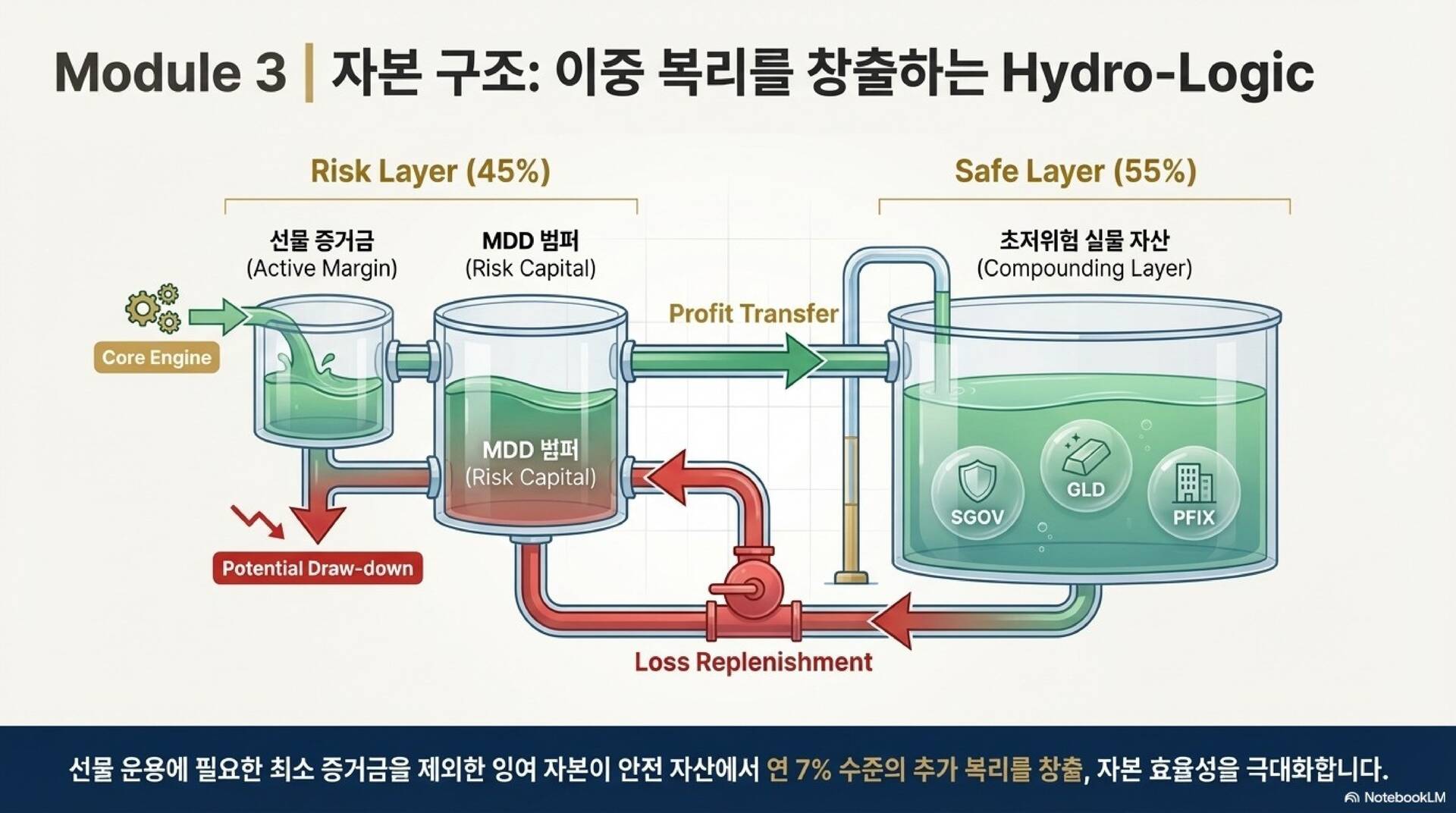
- 3-Bucket Capital Separation: Secures shock absorption capacity by separating capital into margin, MDD defense buffer, and safe assets.
Validation Practices Summary
- Eliminates Look-ahead Bias using the T-1 data rule.
- Calculates KRW-based performance of overseas strategies via exchange rate synchronization.
- Validates performance under conditions that overestimate commissions and slippage by repeatedly applying Worst-Case Cost Assumptions.
Documentation and External Verifiability
Strategy rules, validation assumptions, and Execution Logs must be compiled into formal reports to accommodate external audits and institutional verification.
Operational Monitoring
- Ensures operational stability through real-time position/performance dashboards, anomaly detection alerts, Execution Log retention, and leverage trigger monitoring.
- Periodic stress tests and slippage scenario validations are mandatory.
Comparative Analysis
ItemWeJump Investment LabsGeneral Domestic Retail Quants
| Strategy Philosophy | Structural Alpha-oriented; Internalizes execution constraints | Factor & short-term momentum-focused; Insufficient reflection of execution constraints |
| Validation Methodology | T-1 Rule, Worst-Case Cost Assumptions, Documentation | Backtest-focused; Tendency to relax cost assumptions |
| Rebalancing Frequency | Adaptive Alpha approx. 8 times/year; CBVR 10~18 times/year | Varies by strategy, but mostly short-term high-frequency |
| Transparency | Concurrent reporting of documented strategy rules, validation assumptions, and live performance | Disclosure of live performance is rare |
| Operational Suitability | Emphasizes execution quality matching institutional standards | Some are research-focused, needing supplementation for institutional suitability |
Interpretation
WeJump Investment Labs possesses capabilities closely approaching institutional requirements beyond the retail level, particularly in terms of live-trading reproducibility, execution engineering, and governance transparency.
In the retail environment, even if strategy documentation exists, it is relatively rare to consistently apply Worst-Case Cost Assumptions, exchange rate synchronization, and T-1 rules. The Lab's approach demonstrates a higher level of real-world orientation in operational engineering and governance.
The Lab is evaluated as an engineering-driven quantitative organization that has deeply internalized the Structural Alpha philosophy into its practice. The Conservative Underfitting and Worst-Case Cost Assumptions applied to both Adaptive Alpha and CBVR are core design principles aimed at increasing live-trading reproducibility. Adaptive Alpha aims for an average of 8 rebalances per year, combining medium-to-long-term moving averages with downside volatility management, while the Triple Defense System provides robust downside protection. CBVR performs 10-18 rebalances per year based on regime recognition, effectively handling exposure adjustments aligned with volatility phases.
Key Implications
- Numerical documentation of execution quality is the absolute key to institutional acceptability. Formal reports containing Execution Logs, slippage statistics, and performance curves under Worst-Case assumptions are required.
- The CBVR 5-day anomaly is a critical variable affecting strategy reliability; continuous forensics and automated defense rules are indispensable.
- Emergency leverage rules must be codified to reinforce responsiveness in the event of extreme liquidity collapses.
References & Links
- Adaptive Alpha Strategy Document Repository: https://wejump3.tistory.com/category/Adaptive%20Alpha%20ETF
- CBVR Strategy Document Repository: https://crowmag2.github.io/wejump/
- CBVR Strategy Anomaly Forensic Report and Sub-day System Application Plan: https://crowmag2.github.io/wejump/cbvr_wiki/cbvr_report/CBVR_Analysis_Report.html
- Adaptive Alpha Strategy and CBVR Strategy Position Real-time Public Channel: https://www.youtube.com/@wejump3/live

'위점프 투자전략연구소 안내' 카테고리의 다른 글
| Adaptive Alpha & CBVR Quant Strategies: 구조적 알파 및 리밸런싱 분석 (1) | 2026.04.24 |
|---|---|
| CBVR Strategy Overview (1) | 2026.03.18 |
| CBVR 전략 개요 (CBVR Strategy Overview) (1) | 2026.03.18 |
| WeJump 투자전략연구소 채팅방 (1) | 2026.03.11 |
| CBVR 전략 : 구조적 평균회귀 기반 주가지수 가공 엔진의 설계 철학 (17) | 2026.01.05 |